Santa Chiara, Naples: The Complete Visitor Guide
Most people arrive at Santa Chiara looking for one building and find two, and one of the two is free. That single confusion accounts for nearly every disappointed face I see on Via Benedetto Croce, and it takes about four minutes to clear up. Here is the place as I would explain it to you standing at the corner.
Planning your visit?The complex sells tickets at the desk only, so a pre-booked guided slot is the one thing you can lock in from home — and cancellation is free up to 24 hours before.
Check tour availabilityTwo visits, one name
The basilica is free. It has its own entrance on the Via Santa Chiara facade, it takes 10 to 15 minutes, and nobody will sell you a thing at the door. The Complesso Monumentale is the other half, and it is the paid one: €7 at the desk, and behind that desk sit the majolica cloister, the Museo dell’Opera, a Roman archaeological area and an 18th-century presepe. One ticket covers all four. The two names you meet online, Chiostro di Santa Chiara and Complesso Monumentale di Santa Chiara, are the same visit and not two different tickets. If you paid €7 and saw only a bare church, you went through the wrong door; if you walked into a bare church for nothing and left, you have not seen the cloister at all. There is a fuller walk-through of both on what is inside and opening hours and entry.
1310, and the court that ordered it
Work began in 1310 under Robert of Anjou and his wife Sancha of Majorca, to a design by Gagliardo Primario, in the Provençal Gothic the Angevin court had brought south with it. The basilica was largely finished by 1328 and consecrated to Saint Clare of Assisi in 1340. Robert’s own tomb stands behind the main altar, which tells you what the church was for: a dynasty putting its name on a city it had recently acquired. Santa Chiara is not the largest church in Naples, whatever the guidebooks imply — the Duomo is larger. What it has is the largest Angevin Gothic nave, and if that distinction sounds like hair-splitting, it is the difference between a building that impresses you and a building that explains a century. I take that argument apart on the churches of Naples.
What happened on 4 August 1943
An Allied bomb hit the basilica on 4 August 1943. The fire burned for two days and took the 18th-century Baroque interior with it, along with most of the Giotto-school frescoes that had survived until then. Restoration ran from 1944 to 1953, and the decision taken then is the one visitors misread today: rather than rebuild the Baroque, the restorers returned the church to its bare 14th-century Gothic shell. So the plainness you are standing in is a choice, not neglect and not an unfinished job. Knowing that is the whole difference between ten disappointed minutes and ten interesting ones.
Vaccaro’s garden and the Massa tiles
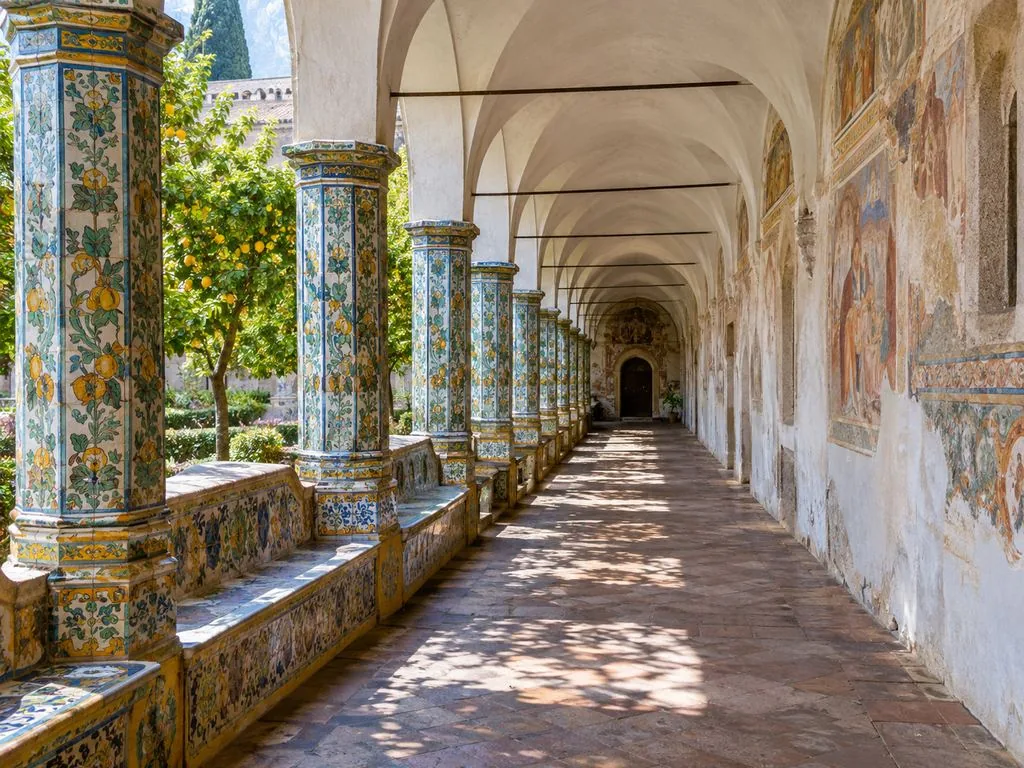
The cloister took its present form in 1739–1742, landscaped by Domenico Antonio Vaccaro. He ran two walkways through the old cloister garden and lined them with 72 tiled octagonal columns, linked by tiled benches, around a middle planted with lavender and citrus trees. Donato and Giuseppe Massa and a workshop of local painters hand-painted the tiles between 1742 and 1749: rural life, hunting scenes, mythology, at the height of a bench where you can read them without stooping. That is the point people miss. The benches are furniture. They were painted to be sat on, and almost everybody edges past them as though the garden were a museum case. Sit down. Photography is allowed; tripods and drones are not. Column by column, the scenes are unpicked on the majolica cloister.
The ticket you cannot buy, and the tour you can
Here is the fact that reorganises the whole decision. The complex sells tickets at the on-site desk only. There is no official online sale and no timed slot: €7 full, €5 reduced for university students, teachers and over-65s with ID, €4 for ages 6 to 17 and FAI members, with last entry 30 minutes before closing and no weekly closing day. Anything advertised as a skip-the-line Santa Chiara e-ticket is a guided tour with admission bundled in. That is not a scandal, but it is worth naming, and the tickets and prices page does the arithmetic.
Which leaves the only question that matters: is the desk ticket enough for you? If you want to look at the tiles for 45 to 90 minutes and then get on with your day, pay at the desk and keep the difference. The case for a guided tour is not queue panic, because the queue is rarely the problem. It is that the cloister carries almost no interpretation. Seventy-two painted columns and no panel telling you what you are looking at, which is a strange way to treat the best-loved courtyard in the city. If you want it explained, a tour is the honest answer, and it is also the only part of the visit you can lock in from home. One warning before you pay: the short cloister tour runs in Italian on its listing, and at least one reviewer booked the Italian slot by mistake, so check the language option. All of them, with what each includes, are set out on guided visits.
Ready to book?
If you want the cloister explained rather than simply entered, this is the short Santa Chiara-only walk — 35 minutes, admission included, free cancellation up to 24 hours before. Check the language option before you pay. The longer walks that take in Spaccanapoli and the Veiled Christ are compared on the historic-centre page, and every option is listed under guided visits.
Frequently asked questions
Is Santa Chiara free to visit?
The basilica is free and is entered from its own door on Via Santa Chiara. The Complesso Monumentale — the majolica cloister, the Museo dell’Opera, the archaeological area and the nativity scene — is a separate paid visit at €7. The full breakdown is on tickets and prices.
Can I buy Santa Chiara tickets online?
No. The complex sells at the on-site desk only, with no timed slot and no official e-ticket. Listings advertising a skip-the-line Santa Chiara ticket are guided tours that include admission. See opening hours and entry for what to expect at the door.
How long do you need at Santa Chiara?
Forty-five to ninety minutes for the paid complex, and ten to fifteen for the basilica on its own. How long you need sets it against a one, two or three-day trip to Naples.