The Majolica Cloister of Santa Chiara: What You Are Looking At
Planning your visit?The complex sells tickets at the desk only, so a pre-booked guided slot is the one thing you can lock in from home — and cancellation is free up to 24 hours before.
Check tour availabilityWhat Vaccaro actually did
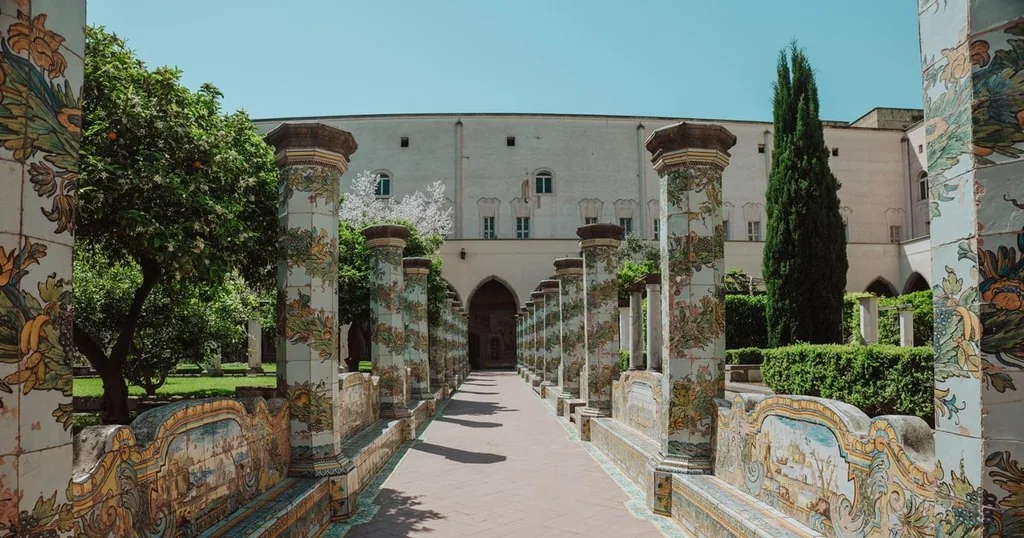
The monastery around it is far older. Building started in 1310 and the church was largely up by 1328, so for four centuries this was a working Franciscan courtyard and not a garden at all. Vaccaro is the man who turned it into one. Between 1739 and 1742 he cut two walkways across the yard, planted the quarters between them with lavender and citrus, and put a tiled column at every point where you would otherwise have had to look at bare stone.
The result is a garden you walk through rather than a courtyard you look at from the edge. That sounds small. Standing in it, it is the entire difference.
Seventy-two columns, and not one of them round
Count them if you like, they come to 72. Each one is octagonal, which matters more than it sounds: eight flat faces give the painters eight panels to work on instead of one curved surface that distorts whatever you put on it. The columns are linked at seated height by benches, and the benches are tiled too, on the back and on the seat.
What the scenes show
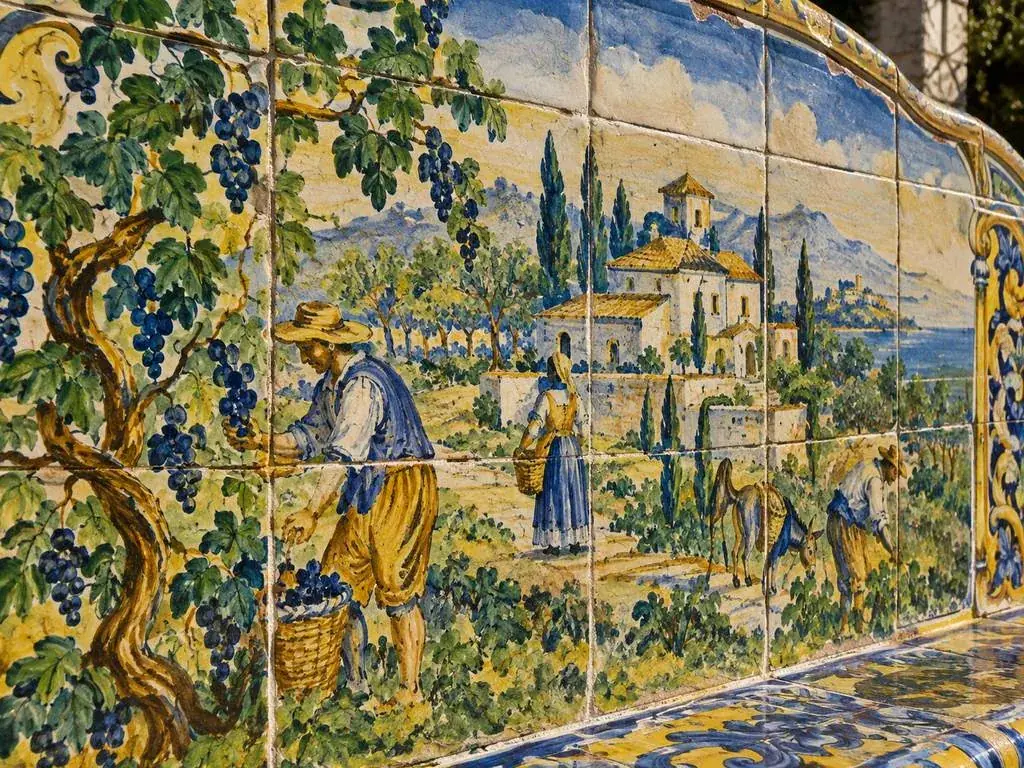
Donato and Giuseppe Massa painted them by hand between 1742 and 1749 with a workshop of local painters. The subjects are rural life, hunting and mythology. Not saints, not the life of Saint Clare, not anything a visitor expects to find inside an enclosed convent. People walk past a hunting party and a classical god on the way to look at the church and never register what they have just seen.
Look at the bench backs rather than the columns if you only have a few minutes. The columns carry the pattern; the benches carry the stories.
The benches are for sitting on
They were built to be sat on and they are still sat on. Visitors hover in front of them taking photographs of a bench and then stand up again. Sit down. The temperature drops a few degrees the moment you come off Via Benedetto Croce into the cloister, the traffic noise goes, and the thing you came to see is at eye level from the seat.
Nobody in there is going to explain this to you
There is no audio guide handed out at the desk, no panel by the columns, no dates on the wall. The complex sells you the door and leaves you to it, which is fine if you already know what Vaccaro and the Massa workshop were doing and thin if you do not. That gap is the honest case for paying more than the gate price, and it is the only case I make: a guide is worth it here because the building refuses to talk, not because of any queue.
The short Santa Chiara-only tour runs 35 minutes and covers the cloister and nothing else. I have written up what it is and is not in my review of the cloister group tour, including the one thing English speakers keep getting wrong when they book it.
Photography, tripods and drones
Photographs are allowed inside the cloister. Tripods and drones are not. Nobody will stop you holding a phone up for as long as you want, and on a bright day the tiles read better in a photograph than they do to the eye, because the camera flattens the glaze.
The cloister is one part of the paid visit, not a separate ticket. The same stub also lets you into the Museo dell’Opera, the Roman excavations and the presepe — see what is actually inside before you decide how long to give it.
Before you go
Check the opening hours and the two entrances first, because the basilica and the cloister are separate doors and people regularly do one thinking they have done the other. If you are still weighing it up, my verdict is on whether Santa Chiara is worth visiting.
Tours that take you into the cloister
 Santa Chiara onlyCloister admission included
Naples: Santa Chiara Cloister Guided Group Tour
 Top pickCloister & Sansevero entry included
Naples: Downtown Tour with Veiled Christ & St Clare Tickets
 Full day oneThree admissions included
Naples: the First Taste of the City Walking Tour
Frequently asked questions
Who painted the tiles in the Santa Chiara cloister?
Donato and Giuseppe Massa, with a workshop of local painters, between 1742 and 1749. The garden and walkways they were painted for had been laid out just before, in 1739–1742, by Domenico Antonio Vaccaro.
How many columns are in the majolica cloister?
Seventy-two, all octagonal, linked by tiled benches along walkways that divide a central garden of lavender and citrus. More background in the complete guide.
Is the majolica cloister the same thing as the Complesso Monumentale?
Yes. Chiostro di Santa Chiara and Complesso Monumentale di Santa Chiara are two names for one paid visit on one ticket, not two separate admissions. The tickets and prices page sets out what that one ticket covers.
Can I take photographs in the cloister?
Yes, photography is allowed. Tripods and drones are not permitted.